Sacred Harp Alaska
What is "Sacred Harp" singing?!
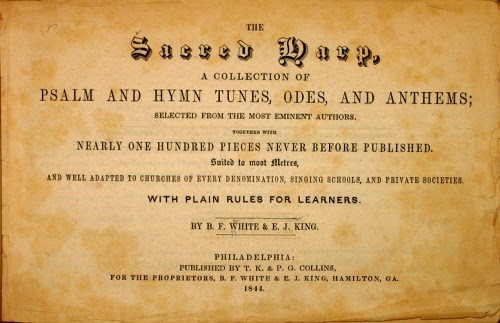
Sacred Harp singing is four-part a cappella music sung from . . . the "Sacred Harp." The Sacred Harp is one of several song books that use "shape note" music notation. It is the song book most frequently used. The musical notes are printed on conventional musical staves, using the standard means to indicate duration (time signature, quarter-notes, half-notes, etc.).
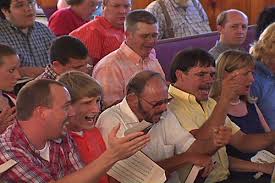
More deeply, Sacred Harp is music created in the 18th and 19th centuries in the United States by home-grown composers. The music is intensely religous, moving, powerful. It is sung with exuberance -- loudly, with little dynamics and no vibrato. It is not "pretty" music. Singers come from all and no faiths. Singing from the Sacred Harp may be a moving experience for many, but it is not a group religous service or a performance.
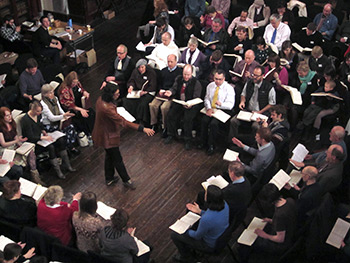
Also, Sacred Harp singing is participatory. There typically is no conductor or leader. There are no auditions, seating arrangements or concern for vocal balance. All singers are welcome, and encouraged, to select and lead songs.
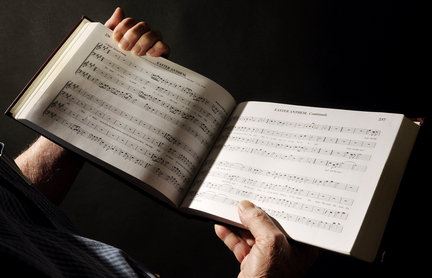
How is it different? The heads of the notes are in shapes. In the Sacred Harp there are four shape: a triangle, a square, a circle and a diamond. These are pronounced fa, so, la and mi. These shapes are associated with specific steps in the major and minor scales. The shapes serve several purposes. When learning a melody, it lets singers sing the shapes and learn the notes and melodies without worrying about also reading the lyrics. Perahps more important, the shapes give musical guidance to the correct relationship between the notes. Whenever a singer sees a triangle (fa), he or she knows it is either the tonic of the song's key, or the 4th. With some time and practice, singing the shapes makes singing easier.
Sacred Harp is sung throughout the United States, and many foreign countries. People gather weekly, monthly and annually to sing. Sings can last a few hours, a day, a couple of days, or even a week. That's a lot of singing!
Finally, remember that the "sacred harp" is the human voice.
Finally, remember that the "sacred harp" is the human voice.